Now that another chapter of Drakaine has been published, I thought it would be fun to talk a little about the Council of Five and how it came to exist in the first place. 😊
It all started with something much simpler: the original Magical Council.
Centuries ago, a group of wizards created it with a rather noble goal in mind: to prevent wars between magical races and to stop anyone from revealing the existence of the magical world to ordinary humans. In other words, to make sure nobody suddenly decided to fight with the Inquisition.
At first, everything was pretty straightforward. Wizards told everyone else what they could and couldn’t do. Simple.
But over time, the Council evolved into a huge international organization with its own rules, laws, internal politics, and endless power struggles.
That’s the form it carried into the modern era. And here’s the funny part: for centuries, absolutely nothing changed. Nothing at all.
And it probably would have stayed that way if not for one wizard.
Terence Barton, the former Head of the Council in the United States.
Barton understood that the magical world had long since stopped belonging exclusively to wizards. He gradually began bringing other races into the Council and eventually managed to pass a law allowing new members to join its ranks.
That’s how druids, gargoyles, liches, night werewolves, and different branches of magic, including dark mages and necromancers, became part of the system.
At the time, this was unheard of. It sparked endless debates, but surprisingly… it worked. People slowly began to trust the Council more.
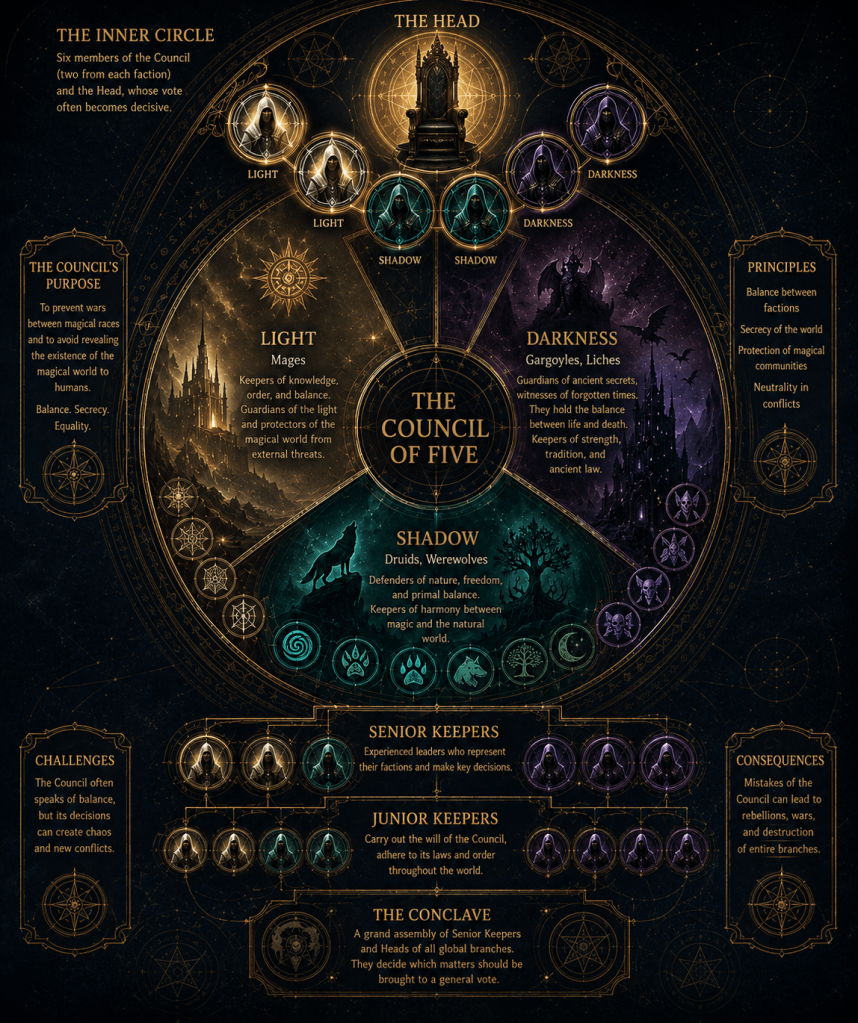
- The new structure was built around three major factions: Light, Shadow, and Darkness. The idea was simple: no single side should ever hold absolute power.
- Each regional Council has an Upper (Inner) Circle consisting of six members (two representatives from each faction: one senior and one junior Keeper) plus a Head whose vote often becomes the deciding one.
- Above them stands the Conclave – a gathering of all senior Guardians and Heads of every regional division. This is where major issues are discussed before being put to a global vote.
- There are currently five divisions: North America, South America, Nepal, East Asia, and Australia & Oceania. There used to be a European division as well, but it no longer exists.
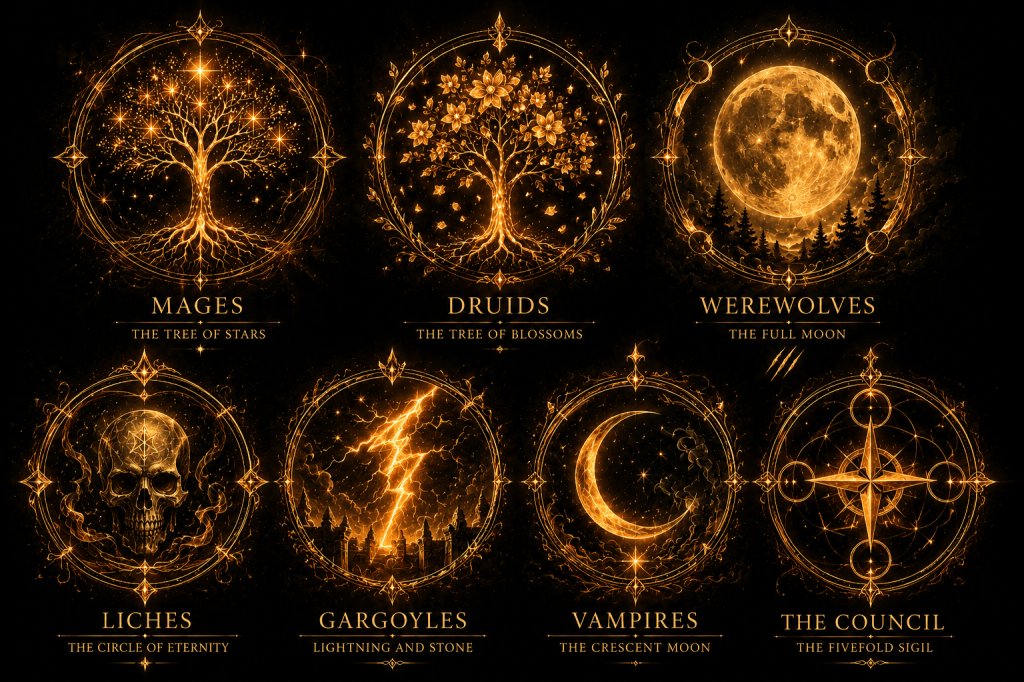
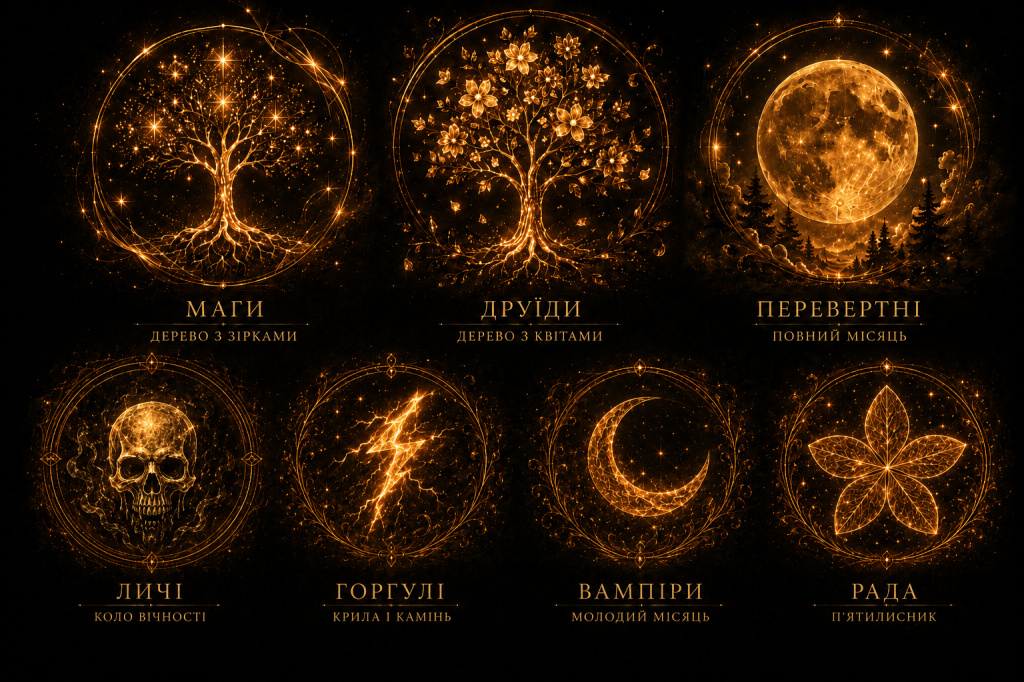
- Every active Council member also carries a seal that represents both their membership and their origin.
Wizards and druids share a tree symbol, although with a small difference: wizards have stars in the tree’s crown, while druids have flowers. Night werewolves and vampires both carry moon symbols. Night werewolves bear a full moon, while vampires wear a crescent moon. Liches carry a skull. Gargoyles carry a lightning bolt.
And then there are those who don’t really fit into a single category, like Francis, James, or Leroy. In those cases, they receive the Council’s universal symbol: a five-leaf emblem.
I’ve always liked this system because it both unites everyone and constantly reminds them of how different they truly are.
Sounds pretty good overall, doesn’t it?
Well… there’s one small problem. The Council loves talking about balance, protection, and safety.
But in practice, it often does the exact opposite. It hates chaos, yet repeatedly creates it. It dislikes extremes, yet constantly falls into them.
That’s exactly what happened with the day werewolves. After their uprising, Barton himself was accused of conspiring with them, removed from power, and his entire project of expanding opportunities for other races was essentially frozen.
The same thing happened to the vampires many years ago. After several murders in Italy, the Council chose a mass execution of twenty vampires instead of conducting a proper investigation.
That decision had consequences. The very next night, vampire clans burned the European division to the ground. It has never been rebuilt since.
And that’s probably why the Council of Five has never been entirely good or entirely bad in my eyes. They genuinely believe they are saving the magical world.
They just happen to create even more problems along the way.
We’ll see whether they finally manage to break that cycle this time. 😊
~~~
Що ж. Раз черговий розділ Дракайни вже опубліковано, можна трохи поговорити про Раду П’яти і про те, як вона взагалі з’явилася. 😊
Насправді все починалося зі звичайної Магічної Ради.
Колись її створили чарівники з доволі благородною метою: не допустити війни між магічними расами й не дати комусь надто активно демонструвати людям існування магічного світу. Іншими словами, щоб ніхто раптом не вирішив показати інквізиції, де раки зимують.))
Спочатку все було досить просто. Маги казали всім іншим що робити, а що ні. Просто і зрозуміло. Але з часом Рада перетворилася на величезну міжнародну структуру зі своїми правилами, законами, внутрішньою політикою й боротьбою за вплив. Такою махиною вона війшла в сучасність. А в ній, уявіть, сторіччями нічого не мінялося. Зовсім. І ще довго не змінилося б, якби не один чарівник.
Теренс Бартон. Колишній Голова Ради П’яти у США.
Бартон чудово розумів, що магічний світ давно перестав бути для одних лише магів. Тому він почав поступово залучати до Ради представників інших рас. І зумів протягти закон про прийняття до Ради нових членів. Так у її лавах з’явилися друїди, горгули, личі, нічні перевертні, а також маги різних напрямків, включно з темними магами та некромантами.
Це було нечувано для того часу, викликало багато…сперечань, але спрацювало. І до Ради стали відноситися з більшою довірою. А нову структуру Рад побудували таким чином:
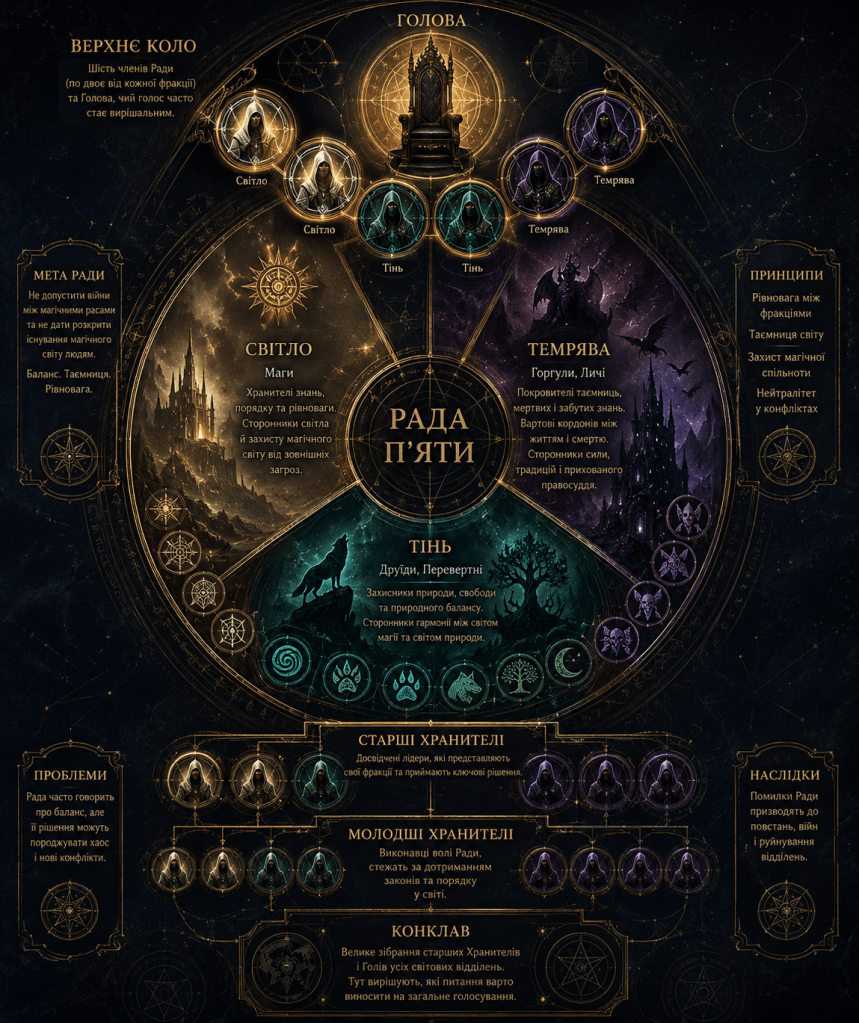
- Всі поділяються на три великі фракції: Світло, Тінь і Темряву. Ідея проста: жодна зі сторін не повинна отримати абсолютну владу. Тому кількість представників збалансована в межах однієї Ради.
- Кожна Рада має Верхнє коло: шість членів Ради (по двоє від кожної фракції – старший та молодший Хранителі) та Голова, чий голос часто стає вирішальним.
- Над ними стоїть Конклав – велике зібрання старших Хранителів і Голів всіх світових відділень. Саме там вирішують, які питання варто виносити на загальне голосування.
- Відділень всього п’ять: Північна Америка, Південна Америка, Непал, Східна Азія, Австралія та Океанія. Існувало ще Європейське відділення, але його було ліквідовано.
- Всі дійсні члени Ради мають власні печатки. Вони одночасно позначають і приналежність до Ради, і походження її власника.
Щодо печаток. У магів і друїдів символом є дерево. Щоправда, вони трохи відрізняються: у магів у кроні дерева розташовані зірки, а у друїдів – квіти. У нічних перевертнів і вампірів символом став місяць. Але теж не однаковий. У нічних перевертнів – повний, а у вампірів – молодий. Личі носять печатку у вигляді черепа, а горгули – блискавки. А є й ті, кого складно віднести до якоїсь однієї категорії. Наприклад, Френсіс, або Джеймс чи Лерой. У таких випадках використовують універсальний символ Ради: п’ятилисник. Мені завжди подобалося, що ця система водночас і об’єднує всіх, і постійно нагадує, наскільки різними вони насправді є.
Звучить в цілому непогано, правда?
От тільки є один нюанс. Рада любить говорити про баланс, захист і безпеку. Але дуже часто на практиці робить зовсім протилежне. Вона не терпить хаосу, але сама його породжує. Не любить крайнощів, але регулярно до них вдається.
Саме так сталося і з денними перевертнями. Після їхнього повстання самого Бартона звинуватили у змові з ними, усунули з посади, а його проєкт із розширення прав інших рас фактично заморозили.
Так само сталося і з вампірами багато років тому.
Після кількох вбивств в Італії Рада замість повноцінного розслідування просто проголосувала за масову страту двадцяти вампірів. І це рішення мало свої наслідки. Наступної ж ночі вампірські клани спалили Європейське відділення дотла. Відтоді його так і не наважилися відродити.
І, мабуть, саме тому Рада П’яти ніколи не була для мене однозначно хорошою чи поганою. Вони щиро вірять, що рятують магічний світ. Просто дуже часто дорогою до цієї мети ухвалюють рішення, які створюють ще більше проблем.
Подивимося, чи вийде в них розірвати це замкнене коло цього разу.

